BOCCIA ENGLAND TALENT SQUAD: Developing the Future of Boccia

At Excel during the Paralympics, and since, I have heard many athletes express a wish to play for GB in Rio. The path to international success is as challenging in boccia as any other sport. Unfortunately dreams do not come true by wishing but they can become a reality through hard work and careful planning.
The recently established Boccia England Talent squad is a stepping-stone on the way to representing a Home Nation and then Great Britain. Players are selected through achieving at National competition or being identified by the selection team as having genuine potential. This might mean someone who has shown skill in Regionals or an Open competition but only been playing for a few months, or a young athlete who has played for several years and is now maturing and developing in their sport and able to compete at a senior level.
Author: Liz Moulam
*** Read all of this story in the world’s 1st Boccia magazine – “Boccia Inclusive” here. Sign up to subscribe regularly here. Find out more about Boccia Inclusive by visiting its Facebook page here. ***
Channel 4 release online Boccia game – did you miss this?
The game, developed by Preloaded on behalf of Channel 4, is playable online here:
BBC – GCSE Bitesize – Boccia
BBC’s look at Boccia – go here for information especially for those new to Boccia.
Case Study – Boccia – A look back…
Out of the twenty sports that make up the Summer Paralympic Games, Boccia was the one which we felt summed up the games for us. It isn’t an Olympic sport and so helps represent the difference of the games and the importance of the different sports involved. It is also a really exciting sport which we felt would work brilliantly as a game, and Channel 4 agreed.
Boccia is a turn based game based on similar rules to Boules, but devised specifically for athletes with physical disability who require a wheelchair. The aim of the game is to throw leather balls as close to the target jack as possible.
The game has various modes for players to access once they’ve chosen their nationality. Quick play gets players to the heart of the action in a simulated Boccia court either playing against the computer with highly competitive and realistic AI or against another player on the same machine.Choose the number of ends and play away.
Tournament mode puts you in a simulated tournament, playing against the best names in the sport. Play through from the quarter final stages to see if you can beat the professionals. Arcade mode focuses on skills, from target practise through to speed and strategy in a technical setting.
Boccia Rule Changes After London 2012
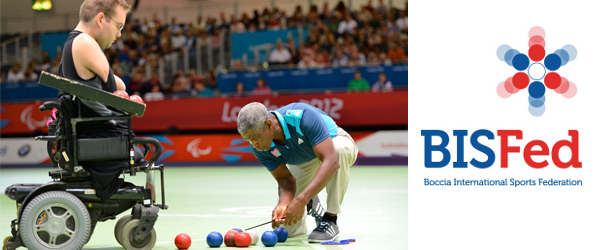
After each Paralympic Games, the governing body of international boccia – now BISFed (Boccia International Sports Federation) – opens submissions for changes to the official rules. The submission process from nations is now over and draft changes have just been announced, and can be downloaded here.
BISFed is inviting comments on the draft changes.
I have submitted to them written comments in the following areas:
Sections 5.2.1 and 5.3.1: Pairs and Team Divisions
Section 6.10.2: Completion of End
Section 9.1 and 11.1: Movement on Court
Section 9.5: Movement on Court
Section 18.1: The Captain’s Responsibility
Section 19.2: Warm up Procedures
Section 24: Protest Guidelines
I am presenting my proposals publicly and on individual pages, so that the boccia community can comment on each one separately. An athlete was not on the very small committee that decided which proposals to reject or approve. It is very important that we hear from as many players as possible so that the rules reflect realities of the game.
The Boccia International Sports Federation – now launched
The Boccia International Sports Federation was launched on 1 January 2013 following an historic resolution by the Boccia – playing nations that the sport needed an independent governing body. We hope you will find the website informative and useful. Please email us any comments or ideas you may have by clicking here
We are now accepting membership applications. Please download the form below, complete and sign it then scan and e-mail it to info@bisfed.com
via Home.
Jakub in national spotlight for Boccia
A DISABLED Pendle youngster who plays boccia has qualified to play in a national event later this year.
Jakub Drozdzowski (14), from Nelson, has duchene muscular dystrophy. He will take part in the boccia nationals in May at Ponds Forge in Sheffield.
Jakub, along with fellow members of the Pendle boccia team, competed in the Northern championships in Liverpool in early December.
The youngsters were identified as talented in the sport through Lancashire’s Sports Playground to Podium initiative. It was important that they had the opportunity to compete in this high level competition.
Barbara Atkinson, from the Pendle Schools Sports Partnership, said: “I’d firstly like to congratulate Jakub on qualifying for the boccia nationals. He has only been playing the sport a short time and this is a real achievement
via Jakub in national spotlight – Local News – Pendle Today.
Paralympic Boccia – Information, History, Rules
Boccia is a target sport that tests muscle control and accuracy, demanding extreme skill and concentration at the highest level.
Believed to have Ancient Greek origins, Boccia is a tough test of nerve, tactics and skill. Played on a rectangular court by individuals, pairs and teams, the sport offers both tension and excitement, as athletes aim to land balls close to a target ball, across a series of demanding ends. The sport is similar to boules or petanque.
via Paralympic Boccia – Information, History, Rules | London 2012.
Bocce – A brief History
Throwing balls toward a target is the oldest game known to mankind. As early as 5000 B.C. the Egyptians played a form of bocce with polished rocks. Graphic representations of figures tossing a ball or polished stone have been recorded as early as 5200 B.C. While bocce today looks quite different from its early predecessors, the unbroken thread of bocce’s lineage is the consistently common objective of trying to come as close to a fixed target as possible. From this early objective, the basic rules of bocce were born. From Egypt the game made its way to Greece around 800 B.C. The Romans learned the game from the Greeks, then introduced it throughout the empire. The Roman influence in bocce is preserved in the game’s name; bocce derives from the Vulgate Latin bottia, meaning boss.
The early Romans were among the first to play a game resembling what we know as bocce today. In early times they used coconuts brought back from Africa and later used hard olive wood to carve out bocce balls. Beginning with Emperor Augustus, bocce became the sport of statesman and rulers. From the early Greek physician Ipocrates to the great Italian Renaissance man Galileo, the early participants of bocce have noted that the game’s athleticism and spirit of competition rejuvenates the body.
As the game enjoyed rapid growth throughout Europe, being the sport of nobility and peasants alike, it began to threaten with the health of nations. The popularity of the game was said to interfere with the security of the state because it took too much time away from archery practice and other military exercises. Consequently, Kings Carlos IV and V prohibited the playing of bocce, and doctors from the University of Montpellier, France, tried to discredit the claim that playing bocce had great therapeutic effect in curing rheumatism.
In 1576, the Republic of Venice publicly condemned the sport, punishing those who played with fines and imprisonment. And perhaps most grave was the condemnation by the Catholic Church which deterred the laity and officially prohibited clergyman from playing the game by proclaiming bocce a means of gambling.
via Bocce History.
Boccia – What Wikipedia has to say…
Boccia (pron.: /ˈbɒtʃə/ boch-ə) is a portuguese precision ball sport (maxime, from Senhora das Dores, Condeixa-a-Nova), similar to bocce, and related to bowls and pétanque. The name Boccia is derived from the Latin word for boss – bottia.[1] The sport is contested at local, national and international levels, by athletes with more severe physical disabilities. It was originally designed to be played by people with cerebral palsy but now includes athletes with other severe disabilities affecting motor skills. In 1984 it became a Paralympic sport, and in 2008 was being practised in over fifty countries worldwide.[2] Boccia is governed by the Cerebral Palsy International Sports and Recreation Association (CPISRA) and is one of three Paralympic sports that have no counterpart in the Olympic program.




 news from the world of Boccia