Boccia team earns praise after NSW championship effort

THREE hard-working members of Southern Cross K-12 School Ballina Support Units boccia team have earned resounding praise after rubbing shoulders with statewide contestants.The team, consisting of special needs students Anthony Pitt, Jayden Watson and Liam Hourigan recently appeared at the New South Wales championship tournament at Sydneys Olympic Park complex.
via Boccia team earns praise after NSW championship effort | Northern Star.
Timsbury volunteers game for Boccia referee role
A pair of dedicated volunteers from Timsbury have grasped the chance to become fully fledged sports referees adjudicating in front of packed crowds at last month’s Special Olympics.
Dave Ransom and Mike Knight, both volunteers at Greenhill House, a Leonard Cheshire Disability residential service for disabled people in Timsbury, were given the opportunity to become Boccia Award Officials skilled to referee, thanks to an award-winning sports project for disabled people in Bath.
Both got the boccia bug to play the paralympic precision ball game.
Last month Dave and Mike got to test their mettle as newly qualified coaches as part of the Special Olympics 2013 National Summer Games Boccia Competition, which was held in B
via Timsbury volunteers game for referee role | This is Somerset.
Welcome – GB Boccia
Boccia is a Paralympic sport for athletes with disabilities that have a major impact on motor skills. Boccia is a target ball sport belonging to the same family as petanque and bowls.
The GBBF was formed in 2007 with the aim of bringing together the home country agencies responsible for the delivery of elite level Boccia in Great Britain at that time; CP Sport England and Wales (Boccia Engalnd now have responsibility), Scottish Disability Sport and Disability Sport Wales.
The GBBF’s primary role is the selection and development of the GB Boccia squad. The GBBF is responsible for sending a GB team to European Championships, World Championships and World Cups to qualify teams and pairs to represent Great Britain at the Paralympic Games.
Great Britain sent a full team of nine players to the 2012 Paralympic Games in London and won two medals. David Smith won Silver in the BC1 Individual competition and the BC1/BC2 Team of Smith, Nigel Murray, Dan Bentley and Zoe Robinson won Bronze.
via Welcome – GB Boccia.
The world of boccia tactics

Palmerston Norths Greig Jackson is not the type of man to let a disability get in the way of his sporting endeavours. Kirsty Lawrence spoke to the captain of New Zealands national boccia BC3 team ahead of the Asia-Oceania tournament in Sydney.The controlled movement of propelling six smooth, round leather balls requires concentration, muscle control, accuracy and tactical awareness.For Greig Jackson, 47, these skills have built up over time and led to him being selected as the captain of the boccia BC3 team for New Zealand for the upcoming Asia-Oceania tournament.But Jackson is an athlete with a difference. He has cerebral palsy and his sport, boccia, is played at an international level specifically for people with the condition.
Boccia champ Thomas in line for top award
A determined teenager who has overcome his disability to be a budding sporting champion has been nominated for a top award.

Inspirational Thomas Holmes, aged 15, has to use a wheelchair because of cerebral palsy but has scooped a host of medals for the Paralympic sport of boccia .
The youngster, a pupil at King Ecgbert School in Dore, is now hoping to take home another prize from the Yorkshire Child of Courage awards next month.
Thomas’ proud dad Martin, of Heeley, said: “We are absolutely ecstatic that Thomas has been nominated.
“Thomas never lets anything stop him.
“If there is any obstacle there he will try and get round it.
“He started off playingboccia three or four years ago and he has just gone on from there. At first he thought it was a bit boring but he just got into it.
“He took part in the Rotary district disability games in Barnsley and did so well he came home with four trophies and medals.”
Thomas won a Star Superkids award for his triumph over adversity earlier this year – and has even motivated his dad to become a qualified boccia coach.
He was nominated for the Yorkshire Child of Courage prize by Karen Codling, chairman of the Sheffield Smashers Boccia club which Thomas and his family are involved with.
Karen, a partner at law firm Irwin Mitchell which sponsors the club, said: “In the two years I have known Thomas he has come on really well.
“I have learned a lot from Thomas and now I can’t believe how competitive he is.
“He has done so well in all the competitions we have entered him into and he always wants to be on the winning team.”
Winners of the awards – which aim to recognise youngsters across the county for their achievements and bravery – will be revealed at a ceremony in Leeds on Friday, October 4.
Boccia featured at the first UK National Paralympics Day
Today sees the first National Paralympics Day – with a free event held at London’s Queen Elizabeth Olympic Park, combing sporting events with a showcase of disability art.
Visitors can enjoy a day of Paralympic sport at the newly re-opened Copperbox venue (which hosted Goalball during the Games) including boccia, wheelchair basketball and seated volleyball.
Liberty, the annual London disability art festival will take place alongside the sporting events. It began as a stand-alone festival in Trafalgar Square 10 years ago and in the last few years has been physically linked with the celebrations around the Paralympic games. This year it’s in the Olympic Park itself.
via BBC News – It’s the first National Paralympics Day – but will there be a second?.
Boccia – according to Wikipedia – part 4
Competition
Boccia can be played on a recreational an or competitive basis. Competitions are organized locally, regionally, nationally, and internationally. The international competition calendar is based on the Summer Paralympic Games quadrennial, with international regional championships in the first year, world championships in the second year, world cup in the third year, and the Paralympic games in the fourth year.
There are approximately 350 internationally-ranked boccia players.[5]
179 athletes from 24 countries and regions attended the 2007 Boccia World Cup during May 9–19, 2007 in Vancouver, BC, Canada[6] for their last opportunity for classification and achieve international ranking for the 2008 Summer Paralympics in Beijing.[7]
88 athletes from 19 countries competed at the 2008 Summer Paralympics in Beijing held 7 to 17 September. Brazil and Korea were ranked first equal over all, both countries finishing with two gold medals and one bronze medal each.[8]
Athletes from 36 countries attended the 2010 Boccia World Championships, and 28 countries participated in the team competition. The balance of power in recent years has shifted from European dominance to a more world wide competitiveness with Brazil leading the BC4s and Korea the BC3s. The dominant force of the Mixed Team has only recently changed hands from GB to Korea but the former power houses Spain and Portugal can never be ruled out.
Boccia – according to Wikipedia – Part 3
Classification

To be eligible to compete in boccia at national or international level, athletes must have a disability and be in a wheelchair, as a result of cerebral palsy, or another neurological condition that has similar effects, such as muscular dystrophy or traumatic brain injury. Players are examined to determine the extent of their disability and then assigned to a sport class, designed to allow them to compete against other athletes with a similar level of physical function.
Boccia players are assigned to one of four sport classes: depending on their functional ability:
- BC1 – Players in this class throw the ball with the hand or foot. They may compete with an assistant who stays outside of the competitor’s playing box, to stabilize or adjust their playing chair and give the ball to the player when requested.
- BC2 – Players in this class throw the ball with the hand. They are not eligible for assistance.
- BC3 – Players in this class have very severe locomotor dysfunction in all four extremities. Players in this class have no sustained grasp or release action and although they may have arm movement, they have insufficient range of movement to propel a Boccia ball onto the court. They may use an assistive device such as a ramp to deliver the ball. They may compete with an assistant; assistants must keep their back to the court and their eyes averted from play.[4]
- BC4 – Players in this class have severe locomotor dysfunction of all four extremities as well as poor trunk control. They can demonstrate sufficient dexterity to throw the ball onto the court. Players are not eligible for assistance.
Boccia – according to Wikipedia – Part 2
About the game of Boccia
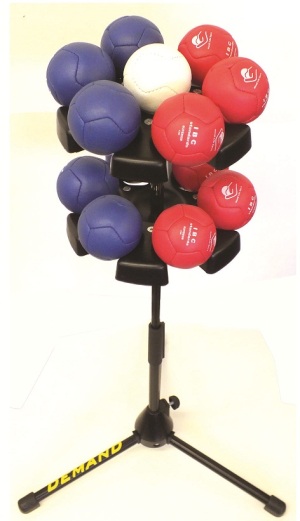
Boccia can be played by individuals, pairs, or teams of three. All events are mixed gender. The aim of the game is to throw leather balls — coloured red or blue (which side gets which is determined by a coin toss) – as close as they can to a white target ball, or jack. The jack is thrown first, then the first two regular balls are played, (first, the player who threw the jack then the opposing side), after which, the side furthest away from the jack goes next in an attempt to either get closer to the jack or knock the opposition’s ball out of the way. In this fashion, each end will continue until one side has played all their balls, at which point, the opposing side will play their remaining balls. The balls can be moved with hands, feet, or, if the competitor’s disability is severe, with an assistive device such as a ramp. At the end of each round, or end, the referee measures the distance of the balls closest to the jack, and awards points accordingly — one point for each ball that is closer to the jack than the opponent’s closest ball. The team/player with the highest number of points at the end of play is the winner. If both teams have the same amount of points after all ends have been played, one additional end is played to determine a winner.
The number of ends and balls in each end depends on the side makeup. Individual competition consists of four ends and six balls per player per end, whilst paired competition is four ends and six balls per pair per end (three per player). Team competition is six ends, and six balls per team per end (two per player).
In pair and team events, a reserve player is allowed. Between ends a reserve can be substituted for a player during a game, but only one substitution per game is permitted.[3]
Boccia is played on a court measuring 12.5 × 6 m with 2 m of empty space around it. The surface of the court is flat and smooth. The throwing area is divided into six rectangular throwing boxes in which the athletes must stay completely within during play. On the court is a V-shaped line over which the jack must cross for the throw to be valid. At the end of the court is the ‘dead ball container’ which balls are put in if they are thrown outside of the time limit, out of the area of play or the athlete violates a rule during his or her throw. A cross marks the position where the jack must be placed if it touches or crosses the boundary line or in the case of a tie break. The balls themselves are made of leather and are slightly larger than a tennis ball, weighing approximately 275 grams and measuring 270 mm in circumference. They are available in different grades of softness and hardness.
Boccia – according to Wikipedia – part 1
Boccia /ˈbɒtʃə/ boch-ə is a precision ball sport, similar to bocce, and related to bowls and pétanque. The name Boccia is derived from the Latin word for boss – bottia.[1] The sport is contested at local, national and international levels, by athletes with more severe physical disabilities. It was originally designed to be played by people with cerebral palsy but now includes athletes with other severe disabilities affecting motor skills. In 1984 it became a Paralympic sport, and in 2008 was being practised in over fifty countries worldwide.[2] Boccia is governed by the Cerebral Palsy International Sports and Recreation Association CPISRA and is one of three Paralympic sports that have no counterpart in the Olympic program.




 news from the world of Boccia