Paralympic preview: Boccia
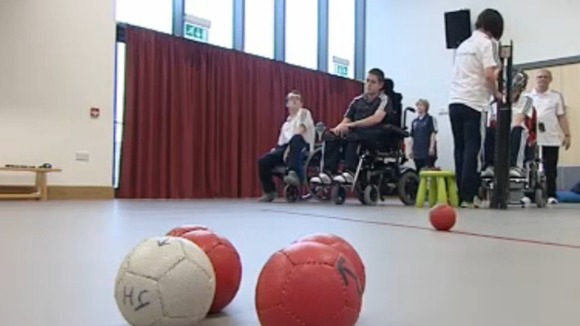
The Paralympic sport of Boccia is a popular one in the South with many talented players coming from our region.
Three of the members of the ParalympicsGB team attended a college in Hampshire where previous medal winners were also alumni. Our reported Penny Silvester has been to meet some players of the game, and ParalympicsGB Boccia coach Barry Bowden, who explains the skills involved.
Swansea Paralympians make their bow
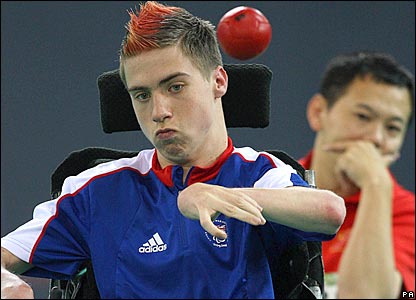
David Smith, who is studying Aerospace Engineering, is representing Great Britain in Boccia. Aged 14, he became the youngest ever player to secure the title of British Champion and he was crowned World Champion at the age of 18. He is currently ranked as the world no. 2 and was part of the gold medal winning BC1/BC2 Team at his first Paralympic Games inBeijing 2008.
David said: “I am happy to have been selected for the London 2012Paralympic Games but my job is only just about to begin and I hope when the job is done I can look back and say: “I did my best!”
via News Wales > Sport > Swansea Paralympians make their bow.
Free taster session to sample boccia – UK
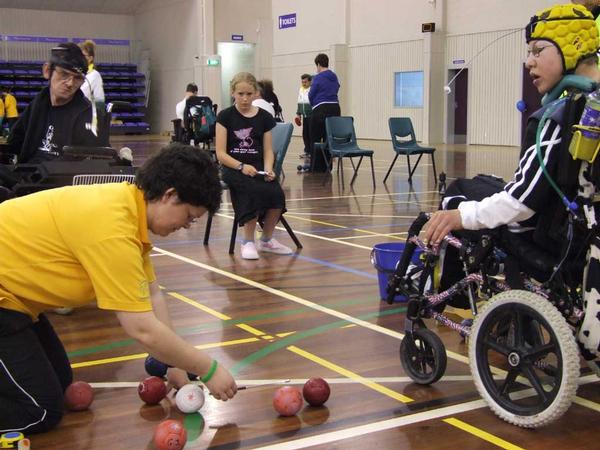
Sport fans in Northampton can get a free taster of the Paralympic sport Boccia this Saturday.
Northamptonshire Sport’s Graeme Wilson will be demonstrating the sport at Northampton Museum and Art Gallery as part of the museum’s Olympic exhibition ‘Going for Gold’ which is showing until October 5.
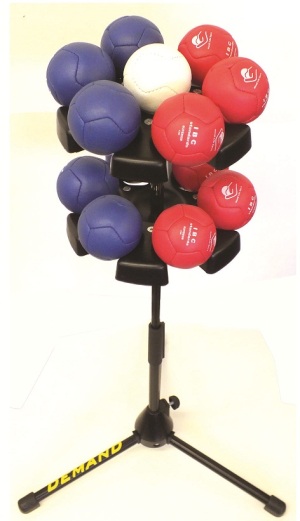
Boccia is a highly skilled sport, similar to bowls, with a big emphasis placed on players’ ability to propel their team’s red or blue balls with distance control and accuracy to get them as near to the white target ball, called a jack, as possible.
At Paralympic level the game is played by people with disabilities that affect their motor skills. The inclusive rules of Boccia stipulate that all players have to be sat down whether they are a wheelchair user or not, which means that everyone plays on a level playing field.
Gotcha boccia! Jess Hunter – profile

Jess Hunter, at 20, is by any test, severely disabled. She is also remarkably pretty. I’m not sure that it is even politically correct to say that. One day last month she ventured to our news studio in her cumbersome wheel chair with her “talent manager” and her assistant, and her coach. Jess is one of ParalympicsGB’s prospects for a gold medal in the up coming Paralympic Games. Her sport is Boccia.
You may not know about – Boccia

Boccia is a precision sport focusing on muscle control and accuracy which resembles boules. Athletes propel balls towards a white target ball known as the jack playing either four ends (that’s rounds to you and me) for individual and pairs and six ends for teams. Each player, pair or team gets six balls during each end and the athlete, pair or team whose ball is closest to the jack at the close of an end scores one point, and an extra point for every ball that’s closer to the jack than the opposition’s closest ball.
Players must be in a wheelchair as a result of cerebral palsy or other related locomotor conditions such as muscular dystrophy. There are four classifications relating to the athletes ability within the sport. They are:
BC1 – athletes with cerebral palsy who can either kick or throw the ball
BC2 – athletes with cerebral palsy who find it a little easier to throw than BC1 athletes
BC3 – athletes with cerebral palsy who cannot independently kick or throw the ball three metres, and who therefore use a ramp
BC4 – athletes with an impairment other than cerebral palsy who have difficulty in throwing the ball
via Five Paralympic sports you may not know about – Now. Here. This. – Time Out London.
Paralympics: Boccia player Nurul profile
 . It was the year she was born, as well as that of SINGAPORE: 1984 is a special year for the Paralympic sport she’ll be representing Singapore in, at the London 2012 Paralympic Games.
The ball-tossing game of Boccia from Greece was introduced 28 years ago as a Paralympic sport specifically designed for athletes with a disability affecting locomotor functions.
The aim of the game is to toss a collection of balls as close as possible to a white ball known as the jack.
Nurul qualified for the Paralympics last December, becoming the first para-athlete to represent Singapore in that sport.
Born with spinal muscular atrophy type 2 (SMA II), Nurul’s condition causes nerve cell loss in her spinal cord which in turn limits muscle movement.
So instead of tossing, players in Nurul’s BC3 category use assistive devices to launch the balls.
The para-athlete uses a head pointer to launch the ball from a ramp, after directing an assistant on the position of the ramp.
Nurul is ranked world number eight in her category, which includes those with cerebral palsy or other locomotor dysfunctions.
via Paralympics: Boccia player Nurul charts game and life with her mind – Channel NewsAsia.
International Boccia Masters 2012 Recap – from Josh Vander Vies

In a recent comment on athletesfirst.ca I wrote that we Paralympians “wrestle with the thought of losing at every training session. Our goal is to perform at an optimum level so that we can win. When we lose though, we lose. We need to work harder next time and although a hug from our loved ones might soften the blow, it does not equal success.”
Over the last days, I poured my maximum effort onto Portuguese boccia courts and came up short. I had some great performances, solid strategies a good mental game and even a reasonable level of consistency. Against the top players in Europe and the Americas, that was not enough. In the game of millimetres that we play, every millimetre counts.
The 2012 Masters began with doubles play, where my partner Marco Dispaltro and I were in a pool with Slovakia and Brazil. In the first game, we started strong, bringing the score to an even 2-2 after 3 of the 4 ends. In the last end, we were focused and ready to surge ahead and take the win. Adrenaline pumping, we missed a few key shots and made, what would end up, a fatal strategic error – attempting a more complicated shot, that would have resulted in the win and a completely blocked jack, instead of a simpler shot that could have just as easily won us the match. The complicated shot did not pan out, and we lost 2 – 5.
We then faced Brazil – two very solid players.
Jess Hunter – the road to London 2012

Based on her continued progress, clear evidence and positive performance indicators, on the 10th April 2012, Jess was named in the GB Boccia alongside Jacob Thomas and Scott McCowan.
Their first competition was the ‘London Prepares’ Test Event at the Olympic Park in early May, where Jess and her playing partner – seventeen year old fellow talent recruit Jacob Thomas were to defeat the pairs ranked 1, 2 and 3 in the World (and others) to win the competition and send a message to the boccia world that the British BC3 Squad are genuine contenders.
Further camps and a domestic competition followed before Jess and the rest of the Boccia squad selected for the Games (a squad of nine, chasing seven medal events) travelled to Porto for the Portuguese Masters. The BC3 Pair tried out some new things but did not progress as well as hoped, still taking two medals in the individual event, with Jess losing only to former Paralympic Champion and World Cup winner Paul Gauthier from Canada.
via Jess Hunter – the road to London 2012 (part 2) | Be Active Win Gold.
Interview with Boccia Athlete David Smith

Interview with Boccia Athlete David Smith
Sport: Boccia
Born: 02/03/89
Lives: Southampton
David has been competing in boccia for 11 years after taking it up at his school. His major achievements include a team bronze at the 2006 Boccia World Championships and team silver at the 2005 Boccia European Championships. He is currently studying for his A-levels.
The Top Scots athletes preparing to compete

PETER and STEPHEN McGUIRE play boccia, a bowls-like sport specifically designed for wheelchair athletes. Stephen, at 27 the younger by two years, got involved first and recruited his brother when he needed a partner for a pairs competition. From Hamilton, they have won titles at British, European and world level.
“I first heard of boccia when I left school,” says Peter, “and I’ve been playing it for about seven years now. It’s specifically designed for people with disabilities like ours.
“I’ve got muscular dystrophy. My father was told I’d be dead when I was nine, but I haven’t deteriorated since I was 12.
“I love the challenge of taking on opponents. Stephen is technically better and I’ve got a tactical mind, so I think it’s a good combination.”
Stephen says, “I’ve always loved to play sport – hockey, pool, darts, bowls. To be honest, it has just been my life.
“I’ve been British champion six times, a European champion and a double world silver medallist. A Paralympic medal would fill my collection, and there would be no better place to do it than at a home Olympics, but I’m not counting my chickens.
“In Scotland we don’t have half as many boccia players as England, but what we’ve got is quality. And the enthusiasm of some of the young players is incredible.”




 news from the world of Boccia