Don’t Dis My Ability – the story of Boccia player, Rachel Sutton
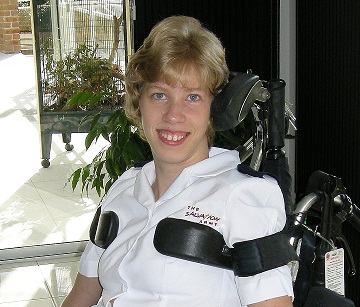
Don’t Dis My Ability – the story of Boccia player, Rachel Sutton
DEMAND: aka ‘Design and Manufacture for Disability’, is a UK based charity. It is a charity dedicated to helping people with disabilities acquire the bespoke equipment they need to help them with their everyday lives. Over the last 30 years, the people at the heart of this vital charity have helped transform the lives of more than 10,000 people f all ages and with all types of disability.
For the last 8 years DEMAND has manufactured Boccia Ramps. DEMAND makes Boccia ramps available so that more people can experience this sport. By doing this we have made Boccia more easily accessible to those who want to add a new sport to their leisure activities. The proceeds from the manufacture and sale of our Boccia products go towards supporting our not-for-profit charitable work.
DEMAND sells these ramps all over the world. Recently we ‘met’ Margaret. ‘Met’ as in we swapped emails. She purchased one our Fusion ramps for her daughter Rachel. They are based in Narwee, Sydney, Australia. In our exchanges we learned of Margaret’s incredible brother, Ross. Margaret told us
I recall my brother Ross leaving for the Paralympics in 1960 and returning with a gold medal. He had won not just Australia’s first gold at the Paralympics, Ross also won the first gold on offer at the first Paralympics games, held in Rome in 1960 (more info here)
I also remember my father using his bow and arrow and shooting an arrow into the back paddock. We all looked for this arrow as you can imagine Ross had just been to the Paralympics and all were quite upset it had got lost Ross told us to stand clear and he shot another arrow in the same direction as my father had shot his and guess what it landed barely an inch away from my father’s arrow. This bow and arrow set of Ross’ is now in the Hall of Fame in Australia. Ross was a humble man and his tremendous feat remained hidden from the world until the advent of the internet. Now his Gold Medal win is known throughout the world.
As we continued our exchanges Margaret offered a great idea about an instruction leaflet to help an Assistant pack away the ramp in its carry-box. She was kind enough to send me photographs of her daughter, Rachel, using the Fusion ramp. I asked Margaret about how Rachel ‘got into Boccia’ – and I heard a wonderful story. I cannot begin to paraphrase it so let me share it with you in the words of Margaret and then later Margaret and Rachel together.
Margaret talking about Rachel
My name is Margaret and I am a Registered Nurse. I trained at the Royal Alexandra Hospital for Children in Sydney Australia.
I adopted Rachel at the age of 2 through our Special Needs adoption program.
Rachel is intellectually normal but has the most severe form of Cerebral Palsy. People used to call it Athetoid Cerebral Palsy.
We all know now it has many different types of tones and Rachel worst form is Dystonia, which affects all her body.
Rachel was the first person in Sydney to attend a normal school with a full time teacher’s aid where she kept up with her peers by using multiple choice questions, a way of answering any question asked. She could not use a communication board as her tones were exacerbated when any effort was applied when using her head or arms. Rachel achieved a technique of raising her eyes to answer yes or when tones were not too great would use her voice with a faint yeh for yes.
Rachel would be very twisted if it were not for The Children’s Hospital Westmead Sydney Australia.
She has a baclofen pump inserted in her abdomen, which regularly infuses the drug into her spinal cavity. Rachel also has regular injections of Botox every 4 months in her limbs. These drug help keep her strong tones more relaxed.
Without these drugs it would be impossible for Rachel to perform any tasks. We have been able to bring out her knowledge she has locked in her brain. Rachel was able to absorb all this knowledge by taking Rachel out everywhere a so called normal child went. We had to give Rachel the same chance to learn as everyone else.
At the age of 20 Rachel is having a great life. She manages her own funding through my help and does not attend a group placement but has her own worker to do whatever she wishes.
One of her choices is attending Boccia.
Having a good education Rachel can go anywhere and find whatever she does is interesting as she now has full knowledge of the world. Her knowledge just does not sit around an underage level but that of and adult so she can make her own decisions and enjoy life where ever she goes. She enjoys movies ranging from drama to comedy. She had a most wonderful sense of humour.
Rachel is a member of the Salvation Army where she completed her Guards award and was presented with the General Guards award from our General who is in England. This is equivalent to the Boy Scouts and Girl Guide Movement.
I won’t say Rachel does not suffer pain. She has had Rods put in her back from neck to pelvis from curvature of the spine. She has pain when the Botox wears off.
Life is so much better because we Focus on “Her Abilities not her Disability.”
Rachel did this most wonderful poem – Don’t Dis My Ability – when at school in English class. She won $3,000.00 for the school and $500 for herself.
Don’t Dis My Ability
When you think my thoughts are far away
You‘d be surprised, what I would really like to say
Of those who think I have no brain
But I would like to let them know
The joke’s, on them of what I know
Technology now is on its way
So one day soon I will have “My Say”By Rachel Sutton
Margaret and Rachel talking about Boccia
Rachel finished school after completing her High school certificate in mainstream school.
Rachel started Boccia this year with a team set up by the Cerebral Palsy Alliance. Sydney. Australia
Rachel is in a wheelchair with very little meaningful movement of her body.
Rachel was finding Boccia very boring as it took Rachel and me her mother/carer such a long time to set up her moves. We felt it was not fare on the other players to wait so long.
This Boccia Fusion ramp has been a great beginning for Rachel.

One does not need to be an Olympic player to enjoy such luxury.
Rachel has found she can enjoy Boccia better as it takes little effort to give me, her carer instructions.
The ramp can rotate smoothly in such small increments. Rachel can tap the side of the ramp she wishes the ramp to turn with her head pointer with little effort.
When using the Fusion ramp I could follow Rachel’s instructions without feeling stressed the ramp was doing its own thing.
The old wooden ramp dropped or moved right or left if Rachel’s wheelchair or I touched it by accident.
I twisted my body and went home with pain in my back each week.
Rachel is a beginner player, which means she does not need to be a top Boccia player to own a Fusion Ramp but she needed it to enjoy the game and have social times with her friends.
“Isn’t it great seeing how they overcome their disabilities so we can see their abilities”.
Rachel has won her first 2 games with the Fusion Ramp.
I cannot add anything to this story other than how happy we all were to hear that Rachel had demonstrated how she brought her poem to life – her own life – Don’t Dis My Ability.
Thank-you tea party attended Boccia Bronze medal winner
A tea party was held by the chairman of the council to thank volunteers in Braintree for their efforts over the year.
Thirty volunteers, who have made a significant contribution to their organisation or the community, were invited to the celebration Harvest tea party hosted by Braintree district council chairman Lynette Bowers-Flint on October 10.
They also had the opportunity to meet Paralympian Daniel Bentley, whose team won Bronze at the 2012 London Paralympic Games in the sport of Boccia.
Alex Herod, 15, volunteers at the Coggeshall Prentice Youth Work Trust. He said: “I have been working at the trust for two and a half years now and I really enjoy it. It’s nice to see kids coming through and feeling part of the community.”
via Thank-you tea party for Braintree volunteers | This is Essex.
University device helps open up Boccia for the visually impaired

A new handheld grid enabling visually impaired people to participate in the sport of Boccia has been developed by Loughborough University designers.
Boccia is a Paralympic sport specifically designed for athletes with a severe degree of physical disability. Men and women compete together in teams, pairs and individual events, attempting to throw leather balls as close as possible to a white target ball.
Until now the sport was not suitable for people with a visual impairment, but this is set to change thanks to a new device created by George Torrens from the Loughborough Design School.
George was approached by sports coaches Mark Beeby and Faye Kanchelski to help develop their concept Tactile Boccia – a spin off from traditional Boccia that would enable the visually impaired to participate in the sport.
via University device helps open up Boccia for the visually impaired.
Boccia for the visually impaired – this device can help
A NEW handheld grid enabling visually impaired people to participate in the sport of Boccia has been developed by Loughborough University designers.
Boccia is a Paralympic sport specifically designed for athletes with a severe degree of physical disability. Men and women compete together in teams, pairs and individual events, attempting to throw leather balls as close as possible to a white target ball.
Until now the sport was not suitable for people with a visual impairment, but this is set to change thanks to a new device created by George Torrens from the Loughborough Design School.
George was approached by sports coaches Mark Beeby and Faye Kanchelski to help develop their concept Tactile Boccia – a spin off from traditional Boccia that would enable the visually impaired to participate in the sport.
via University device helps open up Boccia for the visually impaired – Loughborough Echo.
Daniel Bentley – Boccia Player Profile
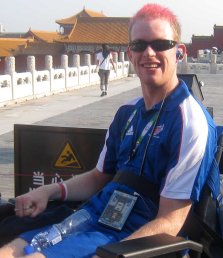
Dan was first introduced to Boccia at Treloar College in Hampshire and he has now been involved in the sport for 12 years. His proudest moment in competition was winning the gold medal in Beijing in 2008.
Angmering team’s national Boccia game glory
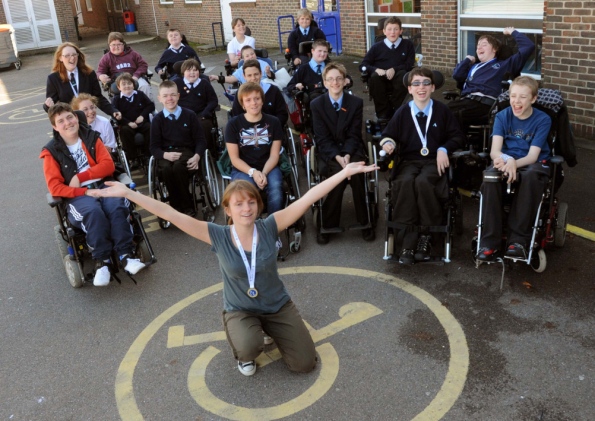
Promising sports students in Angmering have wiped the board at a national competition – once again.
Disabled young people from The Angmering School dominated the week-long Stoke Mandeville Games, winning enough medals to make the school’s trophy cabinet groan under the weight of the new silverware.
Angmering proved a force to be reckoned with in the boccia tournament, with this year’s squad of students from year-eight through to sixth form winning in multiple age categories.
Newcomer Danny Southall took the title in the younger division, while squad members stormed through age categories B and C, earning the top four spots in both, with veteran Matt Berry leading team C to victory and year-10’s Ben Penticost winning in group B.
Manual wheelchair users and more able-bodied students also fared well. They took part in several events including archery, wheelchair basketball, table cricket and poly bat.
Year-nine student Lewis Edwards was the event’s overall winner in the younger category, while promising athlete Dan Ward clinched the prestigious Andy Wallace award for the competitor demonstrating international potential – an accolade with Paralympic legend Dame Tanni Grey Thompson among its previous recipients.
Team manager Steve Richards said: “It was an incredible performance. We dominated the competition from day one.”
via Angmering team’s national game glory – Local – Littlehampton Gazette.
Meet Boccia champion – Nigel Murray

MAKE the most of your chance to meet a Paralympic Boccia athlete when he makes an appearance in the town on Friday October 26.
Leamington’s Nigel Murray will be in the town Sainsbury’s store on Friday between 9.30am and 11.30am to show customers the bronze medal he won in the London 2012 Games and chat about his experiences.
All welcome to come and get involved and chat to the sportsman.
via Meet sporting champion – Community – Kenilworth Weekly News.
Boccia medal winner’s thanks for top team
AN athlete has celebrated his Para- lympic success with the team that helped him become a medal winner.
Swansea University’s triple medallist David Smith thanked the physios who helped him train for the London Games — and showed off the precious metal he won.
The 23-year-old already had a gold in the boccia team event from Beijing when he scooped a bronze in the same event and a silver in the individual discipline this summer.
Boccia is a ball sport specially designed for athletes with a severe degree of physical disability — it was developed by the Swedish disability sports federation in the 1970’s taking inspiration from games such as bocce and boules.
David said his achievements would not have been possible without the commitment of his Swansea University-based physio team, Dean Locking and Amanda Taylor.

via Medal winner’s thanks for top team | This is South Wales.
The story behind the world’s 1st Boccia magazine – “Boccia Inclusive”
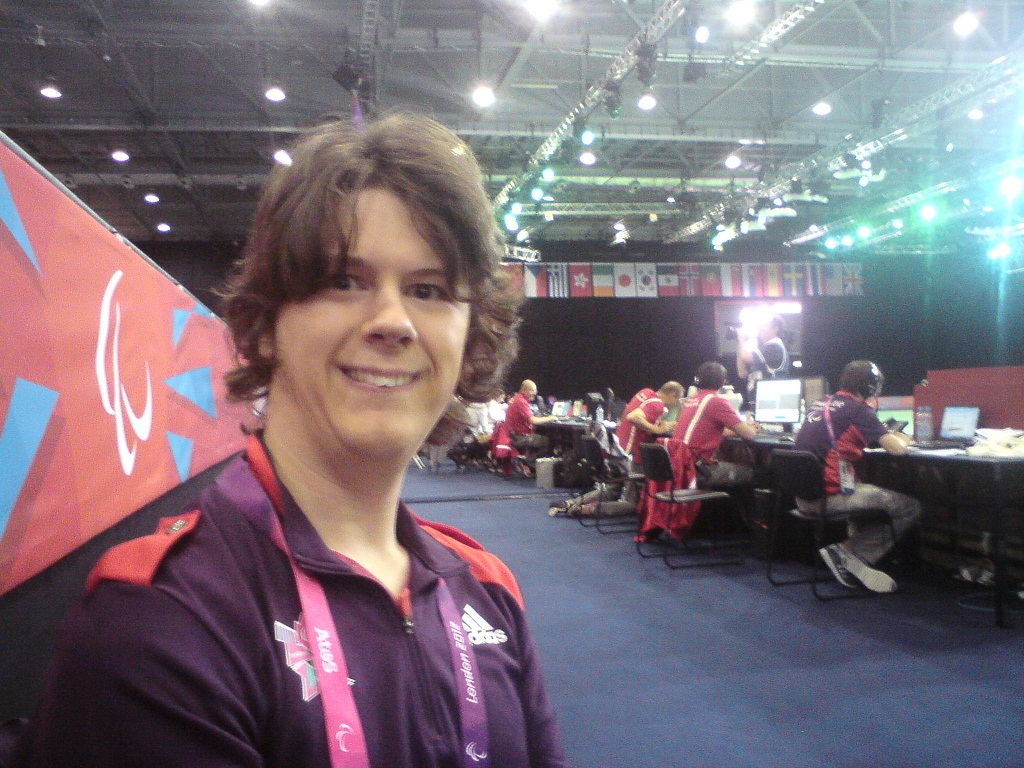
The article below was written by David Hill (above). the Founder of “Boccia Inclusive” – Note: the 2nd issue will be out in November – go here for more info.
Boccia is a truly unique sport in the fact that it caters for a wide spectrum of disabilities. At grassroots level everyone and anyone with any degree of disability can play. Even at elite level athletes, with and without cerebral palsy, can still play. Although, it is only when you look closely at the game you realise how special it really is; people with serve limitations can play using a ramp and an assistant; there are not too many top-level sports that offer this.
This is why I felt Boccia deserved to be recognised and celebrated along with everyone involved in the sport. I had therefore taken it upon myself to create the first magazine dedicated solely to Boccia. I named my magazine Boccia Inclusive; I felt this encompassed the all-embracing nature of the sport perfectly – plus inclusive was a play on journalist lingo, exclusive.
The original aims of the magazine were to bring together a wide range of stories and experiences from across Boccia and share these with everyone. I therefore didn’t just concentrate on players for Issue 1 of the publication; I also acquired contributions from various other people involved in the sport, including coaches, referees and even the Paralympic Boccia Competition Manager for London 2012.
The fact that I started work on the magazine just months before London 2012 was no coincidence; the Games inspired me to get the project off the ground. A friend had given me the idea to combine my two passions together, Boccia and Graphic Design, and create a publication. After dwelling on the idea for ages I decided to put it into action and set a deadline to release the first Issue before the start of the Paralympics. After announcing this on my new created Facebook there was no backing out.
The first thing I did was to try and source out people within Boccia to contribute contents to the edition. Without contents there would be no magazine. After advertising on my Facebook page with little success I began to personally ask people to write articles. As a Boccia player myself I have built up a vast network of friends within the sport. I made contact with some of these and was fortunate to discover that they were more than happy to get involved. Creating Boccia Inclusive has also widen my network of contacts in the world of Boccia, opening up further opportunities to gain new stories in future editions.
I made a feature of the Paralympics with profiles on the GB Paralympians and an article composed by the Team. GB was also helpful in giving my access and permission to use their photographs. This boosted my magazine greatly as photographs had been a major concern due to Data Protection and Copy Right laws.
Having secured articles for the magazine I set about designing the grid system in which the contents would fit. After some trail and error I created a clean composition that worked well with the type and photographs and provided flexibility in the design.
I released Boccia Inclusive Issue 1 on the 23rd August 2012 and got an incredible response from everyone who read it. This completely justifies the time and effort that had gone into creating the magazine. I am currently working on Issue 2 of Boccia Inclusive, due out at the end of November. My future aims for the publication are to make each issue better than the last and to reach more people involved within Boccia, as I am only reaching a fraction on them at the moment.
You can download the 1st issue of “Boccia Inclusive” here.
You can contact him by email – david AT davidhilldesigns.co.uk
Go visit his Face Book page – http://www.facebook.com/BocciaInclusive
Subscribe for free to future editons of the world’s 1st Boccia magazine – “Boccia Inclusive” – here.
Swansea ceremony pays thanks to Olympic Boccia hero
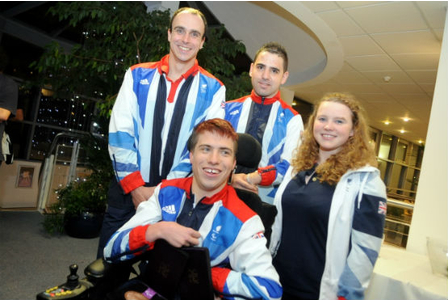
Among the Paralympians present were Swansea-based boccia player David Smith and table tennis star Paul Karabardak, along with swimmers Graham Edmunds and Gemma Almod.
The area’s Olympic stars had been invited but apart from weightlifter Natasha Perdue, sent their apologies.
As well as the sporting talent, volunteers, known as Games makers, who helped out at the two London-based Games, several torch bearers and young ambassadors for sport were also present.
Council leader David Phillips said in his address: “What an amazing summer it was. It proved, as if proof were needed, that Swansea truly is a city of sport.
via Swansea ceremony pays thanks to Olympic heroes | This is South Wales.




 news from the world of Boccia