Jewish Boccia Players required for Paralympics, Israel in 2013

Next summer (between 18th and 30th July), the “Maccabiah” games will take place in Israel. The Maccabiah is an international Jewish athletic event, held in Israel every four years under the auspices of the Maccabi Federation, affiliated with the Maccabi World Union. Maccabiah is open to Jewish athletes as well as Israeli athletes regardless of religion.
The games, always held in Israel, are in fact three separate competitions – “Open,” “Juniors,” and “Masters”. Every Israeli citizen and every Jew not an Israeli citizen, is eligible to compete in the games. Sports in the junior games are open to any qualifying athlete aged 15 to 18. Masters’ sports are divided into a number of different age categories—generally for older competitors. Unlike the Olympic games and other major international sporting events, the sport list for the Maccabiah Games is not set in stone.
For the first time ever it has been decided to have Paralympic sports involved – and there will be a Boccia event too! All Jewish Boccia athletes are invited to participate and register for the Maccabiah through Itzik Azoulay [itzik194@gmail.com]. Please contact him for further information.
The story behind the world’s 1st Boccia magazine – “Boccia Inclusive”
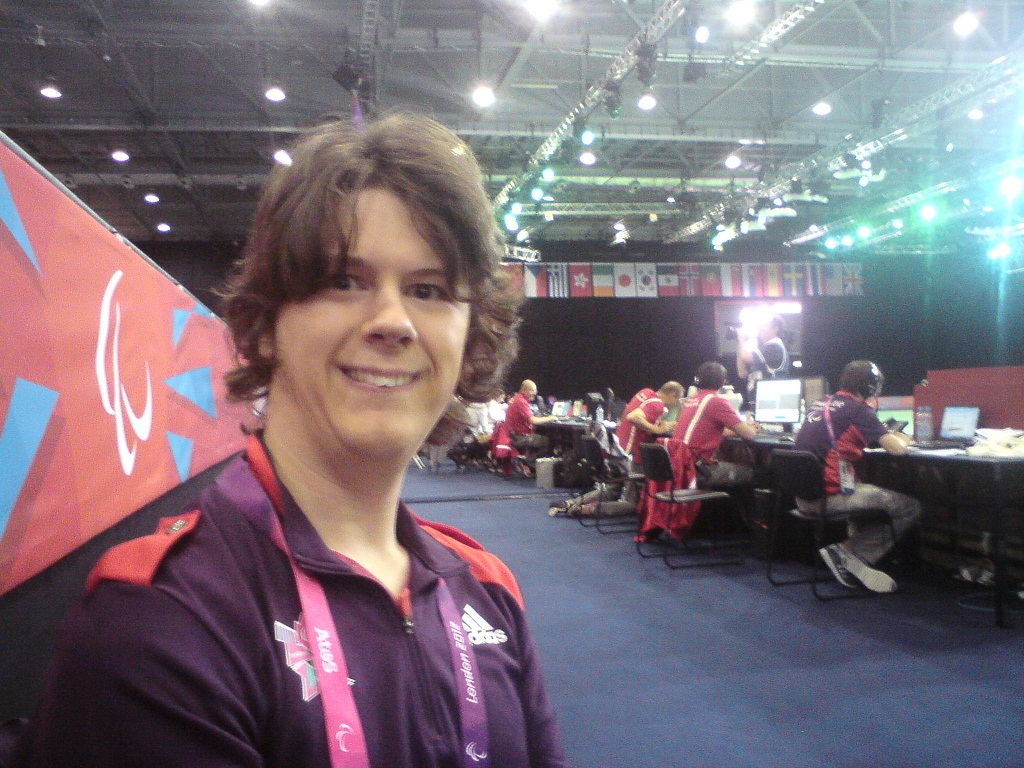
The article below was written by David Hill (above). the Founder of “Boccia Inclusive” – Note: the 2nd issue will be out in November – go here for more info.
Boccia is a truly unique sport in the fact that it caters for a wide spectrum of disabilities. At grassroots level everyone and anyone with any degree of disability can play. Even at elite level athletes, with and without cerebral palsy, can still play. Although, it is only when you look closely at the game you realise how special it really is; people with serve limitations can play using a ramp and an assistant; there are not too many top-level sports that offer this.
This is why I felt Boccia deserved to be recognised and celebrated along with everyone involved in the sport. I had therefore taken it upon myself to create the first magazine dedicated solely to Boccia. I named my magazine Boccia Inclusive; I felt this encompassed the all-embracing nature of the sport perfectly – plus inclusive was a play on journalist lingo, exclusive.
The original aims of the magazine were to bring together a wide range of stories and experiences from across Boccia and share these with everyone. I therefore didn’t just concentrate on players for Issue 1 of the publication; I also acquired contributions from various other people involved in the sport, including coaches, referees and even the Paralympic Boccia Competition Manager for London 2012.
The fact that I started work on the magazine just months before London 2012 was no coincidence; the Games inspired me to get the project off the ground. A friend had given me the idea to combine my two passions together, Boccia and Graphic Design, and create a publication. After dwelling on the idea for ages I decided to put it into action and set a deadline to release the first Issue before the start of the Paralympics. After announcing this on my new created Facebook there was no backing out.
The first thing I did was to try and source out people within Boccia to contribute contents to the edition. Without contents there would be no magazine. After advertising on my Facebook page with little success I began to personally ask people to write articles. As a Boccia player myself I have built up a vast network of friends within the sport. I made contact with some of these and was fortunate to discover that they were more than happy to get involved. Creating Boccia Inclusive has also widen my network of contacts in the world of Boccia, opening up further opportunities to gain new stories in future editions.
I made a feature of the Paralympics with profiles on the GB Paralympians and an article composed by the Team. GB was also helpful in giving my access and permission to use their photographs. This boosted my magazine greatly as photographs had been a major concern due to Data Protection and Copy Right laws.
Having secured articles for the magazine I set about designing the grid system in which the contents would fit. After some trail and error I created a clean composition that worked well with the type and photographs and provided flexibility in the design.
I released Boccia Inclusive Issue 1 on the 23rd August 2012 and got an incredible response from everyone who read it. This completely justifies the time and effort that had gone into creating the magazine. I am currently working on Issue 2 of Boccia Inclusive, due out at the end of November. My future aims for the publication are to make each issue better than the last and to reach more people involved within Boccia, as I am only reaching a fraction on them at the moment.
You can download the 1st issue of “Boccia Inclusive” here.
You can contact him by email – david AT davidhilldesigns.co.uk
Go visit his Face Book page – http://www.facebook.com/BocciaInclusive
Subscribe for free to future editons of the world’s 1st Boccia magazine – “Boccia Inclusive” – here.
Boccia: A Hidden Gem
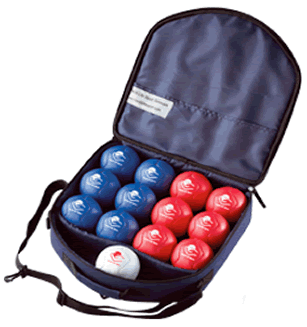
Before the London 2012 Paralympic Games, I knew little of the sport boccia (pronounced bo-ch-a). I hadn’t heard of Great Britain captain Nigel Murray, twice a gold medal winner in the sport, nor of his Beijing team mates Dan Bentley, Zoe Robinson and David Smith, all international class players.
However, after a week watching the sport at ExCeL, a giant exhibition centre in the heart of the London docklands, I had discovered an absolute gem of a sport, one packed with tension and excitement, where a match can be won or lost by millimetres.
On the face of it, boccia is crown green bowls, with competitors in wheelchairs throwing or kicking their balls as close to a jack as possible on a 12.5 x 6 metre flat, smooth hard-court. Only there’s so much more to it than that.
To begin with, competitors are all disabled and split into four classifications. BC1, BC2 and BC3 classifications are for athletes with cerebral palsy, whilst BC4 is for competitors with motor skills disabilities affecting their movement.
My Boccia Legacy
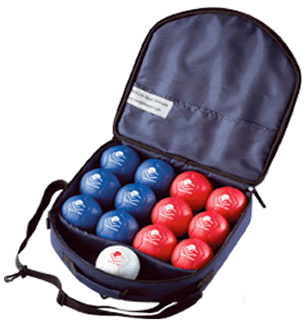
“TV highlights of the boccia world cup would be a great legacy”
Tom Murray, 23, from Southend-on-Sea, is a big boccia fan and plays for the Dovedale Flyers in Colchester. “It’s good to see people ask questions about disabilities, they shouldn’t be afraid to ask; we don’t bite, you know. I would love to see disabled sports stay on the TV. A highlights programme during the boccia world cup – that would be a great legacy.”
via Work to create a legacy to London 2012 starts now – Paralympics – Olympics – The Independent.
Keeping equipment safe and useable

DEMAND would also welcome donations of unwanted or unserviceable equipment from private and public sectors. This equipment can be recycled in a number of different ways, all of which can benefit our disabled clients. DEMAND’S SALES SITE, contains a large number of refurbished items from second hand Wheelchairs through to Walking Aids, Scooters, Beds, Hoists, Grabbers, Bathers, Shower Chairs, Commodes and many more items.
Please click the link to our dedicated Sales website – here.
See more equipment on our ebay site – here.

Or call for more information:
Hertfordshire: 01923 681800
Yorkshire: 01484 666261
Making equipment available to all
Keeping equipment safe and useable
DEMAND has also taken on the role of refurbishing not only privately owned equipment but also setting up contracts for refurbishment work on local authority equipment.
DEMAND would also welcome donations of unwanted or unserviceable equipment from private and public sectors. This equipment can be recycled in a number of different ways, all of which can benefit our disabled clients DEMAND’S SALES SITE, contains a large number of refurbished items from second hand Wheelchairs through to Walking Aids, Scooters, Beds, Hoists, Grabbers, Bathers, Shower Chairs, Commodes and many more items.

Please click the link to our dedicated Sales website – here.
Or call for more information:
Hertfordshire: 01923 681800
Yorkshire: 01484 666261
Getting to the starting line: easier for some than others
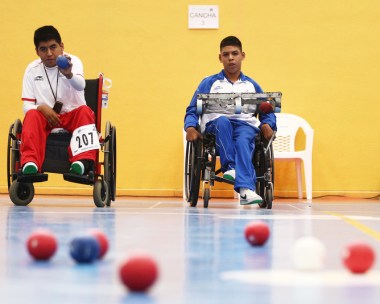
If the International Paralympic Committee’s anti-doping code is about fair play and the classification system is meant to have athletes of equal ability competing against each other then the question of technological advantage between nations must be addressed.
The public fascination with the cyborgs of disability (technology body interface) and the ‘normalising’ of Paralympic bodies has been brought to the fore with Oscar Pistorius’ involvement with the Olympics. What will be interesting to observe is whether all Paralympic bodies and sports get an equality of media coverage.
This includes people with high support needs and the sports that they are engaged in. I just hope that the cerebral palsy athletes in Boccia get the coverage they deserve as much as the high profile sports such as amputee track, wheelchair basketball and wheelchair rugby.
via The Conversation.
Blown off court by a master of the leather balls
Paralympic gold medallist Dan Bentley is trying not to laugh. I have joined the GB boccia player in training at his gym in Great Dunmow, Essex, and have just rolled my third blue ball miles wide of the jack. He knows he is about to clean up, and with three swift shots he knocks my paltry efforts off the court and creates a circle of red balls around the jack, leaving me with nothing.
Anyone channel-hopping through the Paralympic coverage this morning may stumble across a sport which at first glance looks not very sporty at all. At 9am, a line of three Britons and three Argentinians will be sitting stationary in electric wheelchairs occasionally rolling red and blue leather balls along the floor of the ExCel centre.
Don’t let appearances deceive you. This is boccia (pronounced to rhyme with “gotcha”), a game as strategic as chess and as tricky as snooker. It is an adapted version of boules or pétanque, played by those with disabilities that affect their motor skills, such as cerebral palsy or muscular dystrophy.
via Blown off court by a master of the leather balls – Paralympics – Olympics – The Independent.
A graphic description of Boccia
The Press Association graphics team have designed a series of graphics explaining the format and rules of Paralympic sports – Boccia (see graphic No. 3)
via Press Associations Paralympic sport graphics

Anybody can take part in sport regardless of disability
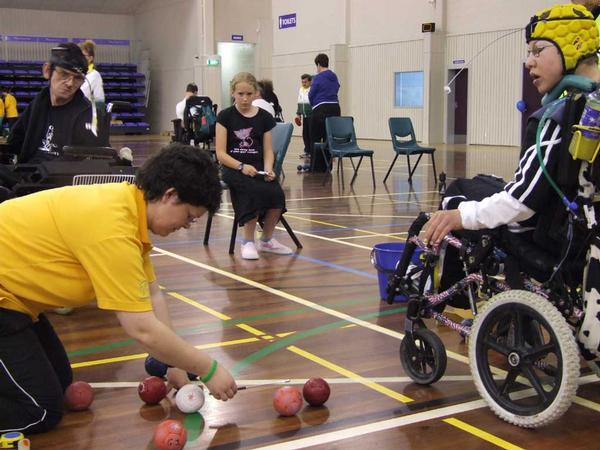 TIM Bingham hasn’t let being confined to a wheelchair stop him from getting stuck into sport.
The 16-year-old, from Hester’s Way, even has his sights set on playing Boccia at the Paralympics.
A rare illness as a child left him with limited movement but three years ago he took up the sport.
The Chosen Hill School pupil said: “Anybody can take part in sport regardless of disability.
“In the sport I do they find different methods to suit your disability. People have a range of disabilities but can still take part. Some people are able to use their hands, some their arms and some are blind and able to play.”
via Anybody can take part in sport regardless of disability | This is Gloucestershire.




 news from the world of Boccia